
Sustainable work without ongoing personal cost
Strengths-informed supervision, coaching, workshops, and organisational development
As leadership responsibility grows
Capable people are often promoted because of their expertise, judgement, problem-solving, care, and ability to get things done. But as leadership responsibility grows, the ways of working that made them successful may need to change.
For some, the shift is from personally doing and solving towards creating the conditions for greater capability, judgement and ownership in others. For more experienced leaders, it may be recognising where decisions, support, or critical work still depend too heavily on them.
When these patterns remain unchanged, leaders can become increasingly central to how work gets done, even while performance continues to look strong. The signs may include:
Too much operational work, problem-solving, or decision-making continuing to flow back to leaders
Limited space for strategic thinking, reflection, and developing others
Growing reliance on a small number of capable people
Responsibility becoming concentrated rather than distributed across the team
Over time, these patterns can shape workload, culture, decision-making, and the capacity of people and teams to work sustainably.

Below the water line
On the surface, performance may still look strong. Work gets done, problems are solved, and capable people continue to meet expectations.
What is harder to see is when the way leadership is being carried is becoming less sustainable, or when there is too little space for reflection, strategic judgement, and developing capability elsewhere.
By the time strain becomes visible, these patterns may already be well established.
This sits within a wider workplace context. Across Australia and New Zealand, employee engagement is 21%, while 49% of employees report experiencing a lot of stress on the previous day. Globally, manager engagement has fallen nine percentage points since 2022, with declining manager engagement accounting for much of the recent fall in overall engagement.
Strengths as a reflective lens
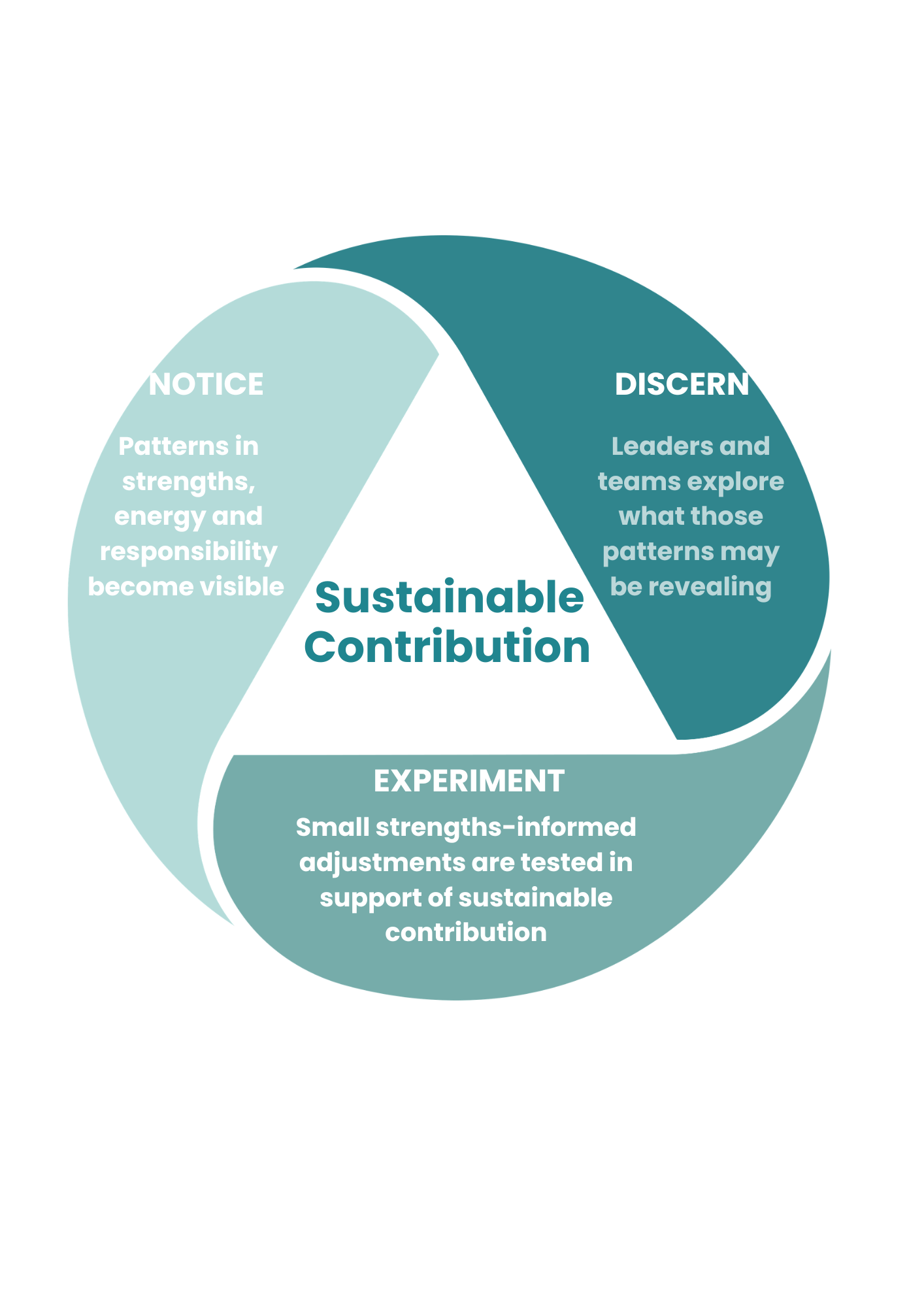
Strengths can provide a useful lens for understanding how leaders respond when work becomes complex, and how patterns of reliance and responsibility may begin to form around them. When considered mainly through the lens of performance or engagement, those patterns can be easy to miss.
A strengths-informed approach gives leaders and teams a shared language for noticing and making sense of what might otherwise be difficult to name.
The question is not simply how to use a strength more, but what the role now requires that strength to do. Sometimes the same capability needs to be used differently. Sometimes the role requires creating the conditions for greater capability, judgement and ownership in others.
Rather than moving straight to a solution, the work can involve testing small, thoughtful adjustments and learning from what happens. Those adjustments may sit with the leader, or extend to how work and responsibility are distributed across the team or organisation. The aim is to discover where the pattern can actually shift, rather than assuming the answer sits with the leader alone.
How the work unfolds in organisations
Organisations may begin with an individual leader, a leadership team, or a broader team, depending on what is most needed.
Each stage can stand alone or build into a broader Strengths & Sustainability Pathway.
A common starting point is individual leader support.
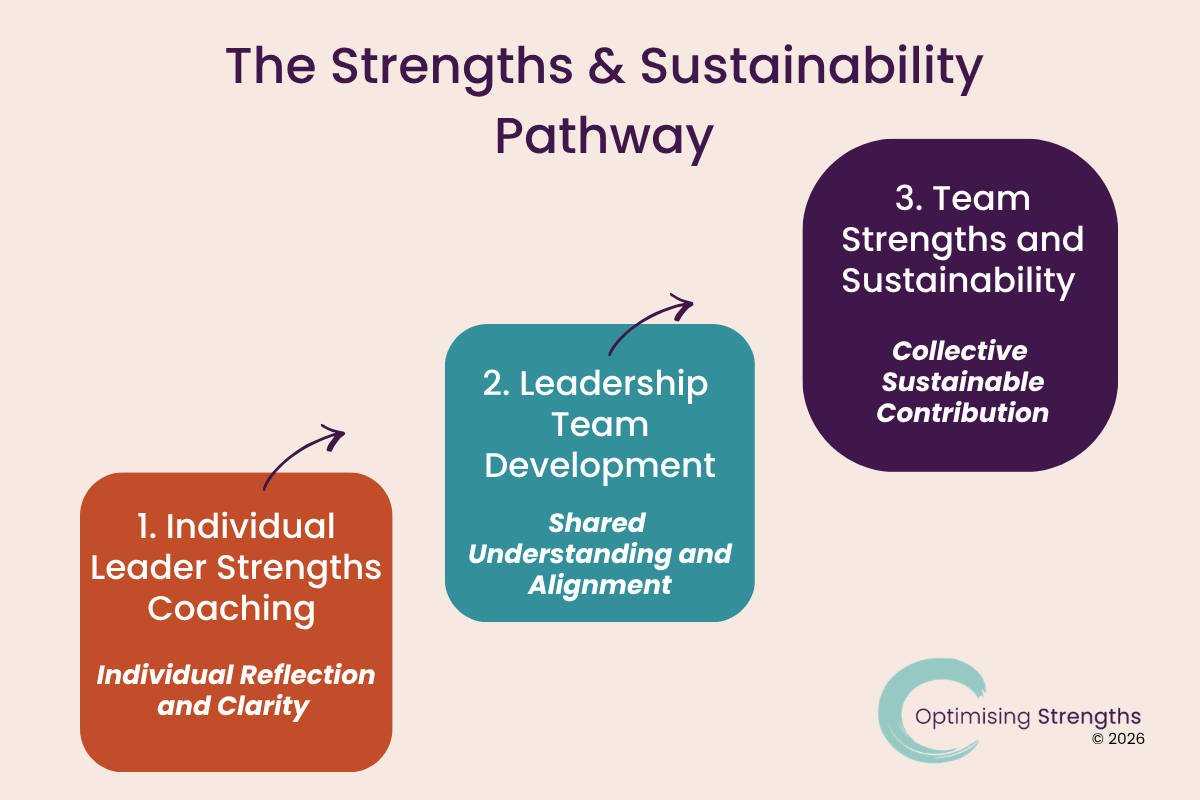
Level 1: Individual leader coaching and supervision
For people moving into leadership, or leaders whose scope and responsibility are growing. Using a Skills Discovery Profile and coaching, leaders explore how their strengths, energy and familiar ways of working may need to shift as the role evolves.
This helps clarify what the role now requires, where existing patterns may be keeping them too central, and what might enable others to take greater ownership.
Leadership supervision can also provide ongoing reflective support as leaders navigate changing responsibilities, relationships, decisions and the demands of their role. Where useful, Skills Discovery can be used more flexibly within supervision as one reflective lens among others.
Delivered through leadership supervision, coaching and tailored in-house workshops
Level 2: Leadership team development
Working with leadership teams to understand how strengths, energy, judgement, decision-making and responsibility are being carried across the group.
The focus is not only on how individual leaders contribute, but on how the leadership team functions as a system: where decisions tend to sit, where work or support repeatedly flows back to particular people, where responsibilities overlap or remain unclear, and where greater interdependence may be needed.
Using Team Profiles, coaching and facilitated workshops, leaders can explore how their strengths interact, clarify how responsibility and authority are shared, strengthen collective judgement, and create more sustainable ways of leading together.
Level 3: Team strengths and sustainability
Working with broader teams through Team Profiles, workshops and facilitated reflection.
The focus is on how strengths, work and responsibility are distributed across the team, how people rely on one another, and whether particular tasks, decisions or forms of support are becoming concentrated in a small number of people.
This helps teams build greater shared ownership, make better use of capability across the group, and develop ways of working that are more sustainable over time.
What this work makes possible
This work can help create:
Greater clarity about roles, expectations, and what leadership now requires
Stronger capability and ownership across teams
More sustainable distribution of work, decisions, and responsibility
Earlier recognition of when strain is building or too much begins to depend on particular people
More space for reflection, sound judgement, and leadership that can be sustained over time
Over time, these conditions can also support greater stability, retention, and engagement.
“Love the use of Skills Discovery as a reflective compass. Thanks for leading us through the profiling and supporting our team with some fantastic strengths work.”
Regional Manager, Community Services
What happens when we start?

We begin with an initial conversation to understand what is happening in your organisation, what you are hoping to support or change, and the wider context around the people or team involved. This may include current challenges, team dynamics, role or structural considerations, and what a useful outcome would look like. From there, we agree a starting point and scope the work around your organisation’s priorities and context.
For team-based work, I may also gather brief input from team members so the design reflects their experience as well as the organisational perspective.
Depending on the engagement, this may include individual leadership supervision or coaching, Skills Discovery profiles, team development, workshops, or a combination of these.
Before the work begins, we clarify practical arrangements including timing, delivery format, confidentiality, any agreed reporting, and how progress will be reviewed. Larger engagements can be staged, allowing the approach to develop as you learn what is most useful.
Finding the right starting point
If you’re noticing too little space for the leadership work that matters most, or increasing reliance on particular leaders, this work helps make the underlying patterns more visible and clarify where attention may be most useful.
Whether you’re exploring support for a single leader, a leadership team, or a broader organisational initiative, you don’t need to know the right format before getting in touch.
A complimentary 30-minute introductory conversation gives us a chance to understand what is happening, talk through the options, and identify the most useful next step.
Frequently asked questions
-
There is some overlap. Supervision can involve mentoring and coaching, but the main difference is the purpose and shape of the relationship.
Leadership supervision is an ongoing, agenda-led reflective relationship. Because I provide external supervision, it is separate from the organisation’s line management processes. The leader brings what is most relevant at the time.
The conversation may involve reflection, support, problem-solving, mentoring or coaching, depending on what is useful. It can also create space to identify areas the leader wants to develop further.
Leadership coaching is usually more focused and bounded. It begins with Skills Discovery and a one-to-one debrief, providing a shared starting point for exploring a leader’s strengths, what their role currently requires of them, and an area they want to understand, develop or approach differently. Where a practical change would be useful, strengths crafting can provide a way to test small, practical adjustments and learn from what happens.
Supervision may suit leaders who would benefit from an ongoing reflective space that can respond to what is emerging over time; coaching may suit leaders who want a more focused, bounded process around a specific aspect of their role or leadership.
-
The content of individual leadership coaching and supervision sessions is confidential, including when the organisation is funding the work.
There are normal limits to confidentiality. For example, information may need to be shared where there is a serious concern about someone’s safety or a legal requirement to disclose it. If a situation arose where I believed information needed to be shared, I would discuss this with the person first wherever possible, including what would be shared and with whom.
An organisation may sometimes ask for general themes, participation information or an overview of how the work is progressing. This would not normally include the detail of individual conversations. Any expectations about reporting or information-sharing are clarified at the outset so everyone understands what is and is not confidential before the work begins.
-
Individual Skills Discovery profiles provide a structured starting point for exploring strengths, energy and patterns of use. The profile prompts inquiry rather than providing a definitive explanation of the person or determining what should change.
Where Skills Discovery forms part of a team or organisational program, results from individual Expert Profiles may be combined to create a Team Profile. This shows patterns across the team without identifying individual results.
How profile information will be used, including any team-level reporting, is explained in advance. The aim is to support useful reflection and conversation across the team, not to label people or draw conclusions from profile information alone.
-
Work can be delivered online or in person, depending on the organisation’s preference.
For Adelaide-based organisations, in-person delivery can be arranged. Interstate delivery is also possible by agreement, with travel and accommodation costs quoted separately where required.
A combination of online and in-person work can also be used where that best suits the organisation and the people involved.
-
This depends on the purpose and scope of the work.
Individual leadership coaching and supervision sessions are one hour. Leadership supervision is usually held monthly. Coaching may involve a smaller number of sessions spaced to allow time for reflection, experimentation and learning between meetings.
Workshops and team development can be designed as standalone sessions or as part of a broader program.
-
Depending on the engagement, useful signs of progress might include changes in role clarity, how responsibility is distributed, confidence and ownership within teams, how decisions are made, or whether leaders have more sustainable ways of working.
Progress can be reviewed through agreed check-ins, participant reflection and observation of what is changing in practice. The aim is not simply to ask whether people enjoyed the work, but to notice what has shifted, what is becoming easier or clearer, and where further attention may be needed.
Where appropriate, the approach can then be adjusted in response to what the organisation is learning.
Other ways to engage with this work

For Leaders
Explore strengths-informed supervision and coaching for leaders as responsibilities grow and ways of working need to evolve.

Public Workshops
Explore how strengths and ways of working may need to evolve as leadership responsibility grows, through reflection, practical experimentation and shared learning.