
Leadership changes what your strengths are being asked to do

Strengths-informed supervision and coaching for leaders when the strengths that got you here need to be used differently
As leadership responsibility grows, being good at solving, helping, deciding or responding is still valuable, but more of the work now needs to happen through other people, not just through you.
The day can quickly fill with solving problems, answering questions and keeping things moving, while the work that needs uninterrupted thinking never quite gets its turn. This is harder still when the role asks you to wear several hats at once, and the demands rarely arrive one at a time.
Where are you in your leadership?
Stepping into leadership
I was good at the work. Why does leading it feel so different?
You are moving from doing the work yourself to enabling other people to do it well. The strengths that made you a strong practitioner or expert still matter, but they may need to be used differently now.
Leading a team
Why am I still so caught in the day-to-day when I’m meant to be leading?
You may be experienced and capable, but solving, advising, checking and stepping in can keep pulling you back into the operational work. The more people rely on you for those things, the harder it becomes to protect space for strategic thinking and build greater judgement and ownership in the team.
Leading leaders
How do I build a leadership team that can make good decisions without everything coming back through me?
At this stage, the challenge is less about whether you can lead well yourself and more about building leadership capability around you, so decisions, support and judgement do not continually have to route back through you.
At any of these stages, you may still be getting things done and meeting expectations, while the effort of continually adjusting is taking more out of you than others may see.
It can be easy to read that as a personal failing: not disciplined enough, not delegating well enough, not ready. Sometimes it is less about capability than what the role is asking you to carry.
The aim is more room to think, a clearer sense of what needs your attention, and more choice about how you want to lead.
“I completed a strengths-based profile and coaching with Sharon… My goal was to find how I could make my work more sustainable, enjoyable, and energising. Over the past 11 months, I've made several changes, and this coaching helped me reach a much better place to continue the important work we do without compromising my own health and wellbeing.
I also found it very valuable to do Leader Profile coaching to understand more about my key leadership strengths and how I can use these to support Contemporary Coordination, my team, our participants, and those we assist and connect with across the industry.”
- Rachel Lafain, Senior Social Worker | Director, Contemporary Coordination
Ways we can work together

Leadership supervision
A good fit when you want an ongoing reflective space that can respond to what is emerging in your role over time.
The focus can move across how you lead yourself, lead others, and shape the work around you.
You set the agenda. I bring a strengths-informed lens to the conversation.

Leadership coaching
A good fit when you want to focus on a particular leadership question, transition or pattern.
Leadership coaching begins with a strengths assessment (Skills Discovery) and a one-to-one debrief, and can continue into a longer coaching process depending on what you want to explore.
The profile gives us a shared starting point. From there, we focus on the leadership situations you want to understand, navigate, or approach differently.
Strengths-informed leadership supervision
Ongoing reflective support as your leadership role evolves
Leadership supervision gives you somewhere to step out of the day-to-day and think about what your role is asking of you, how you are working with others, and what may need greater attention or a different perspective.

What you might bring
You might bring a difficult decision, a team or relationship issue, changing role expectations, workload or responsibility, something that keeps coming back to you, or your own development or wellbeing. The strengths lens helps you explore:
how your strengths are shaping the way you lead
where responsibility, decisions or support are becoming too dependent on you
how judgement, ownership and accountability can be strengthened across working relationships
what you may need to hold, share, delegate or approach differently
When we work together
The first session gives us time to understand your role, what has brought you to supervision, and what would make the space useful to you. We also clarify expectations, confidentiality and practical arrangements.
You do not need to arrive with a clearly defined goal. You may already have something you want to think through, or we may begin more broadly with what your role is asking of you.
Sessions last 60 minutes. Most people meet monthly, although you choose how often.
Skills Discovery is part of my strengths-informed approach to supervision. It is typically introduced within the first few sessions, as another lens on how you work and lead. If something more pressing needs attention, we begin there and introduce it when the time is right.
Skills Discovery is priced separately from supervision.
How supervision supports your leadership
Some conversations need more space to think, others more structure, challenge or a clear outside perspective, and we adjust as we go. I offer different ways of making sense of what you’re noticing, and we test them against your own experience rather than assuming the first explanation is right.
Supervision helps you notice and understand patterns earlier, develop clearer judgement about what stays with you, and, where useful, adjust how you lead as your role changes.
When a practical change is needed, we can start with a small experiment. For example, that could mean changing what happens when someone brings you a problem, shifting where a decision sits, or protecting time for work that requires your attention rather than your availability.
Supervision experience
I have undertaken extensive formal training in supervision at intermediate and advanced levels, and have experience supervising leaders from diverse professional backgrounds.
This includes social work, psychology, human resources, occupational therapy, speech pathology, public health, community services and related human services settings.
This breadth of experience allows the supervision to stay grounded in the realities of your leadership role, without requiring us to share the same professional background.
For social workers, supervision can also be structured to meet AASW CPD requirements.
Ready to explore leadership supervision?
Book a 30-minute conversation to talk through what you're navigating in your leadership role, what you want space to think about, and how we could work together.
“In previous management roles, I tended to get a little burned out, and I wanted to better understand how I could use my existing strengths in a way that didn't bleed as much into my personal time. It helped me identify which strengths I was overplaying, and how these were linked to learned skills I had come to rely on too heavily. Seeing how these patterns interacted gave me insight into why the balance had been slipping over time.”
- Cherice Jenner, Training Specialist
What leadership coaching can explore
Leadership coaching begins with a Skills Discovery assessment and a one-to-one debrief. The debrief is a reflective conversation rather than simply a walkthrough of your report. We explore what stands out across your strengths, energy and patterns of use, alongside what your role is currently asking of you and the leadership situations you want to understand, navigate or approach differently.
If you continue into a longer coaching process, we can explore:
how your strengths are showing up in the role and what your responsibilities now require of you
where familiar ways of working may need to evolve
what actually needs to remain with you and where others need greater ownership
what could create more room for the work only you can do
Sometimes greater clarity changes how you understand your role or a particular situation. When a practical change is needed, that might involve changing how you use your own strengths or creating the conditions for greater judgement, capability or ownership to develop across your working relationships. Strengths crafting can then turn that understanding into a small, practical experiment in how you lead or share responsibility.
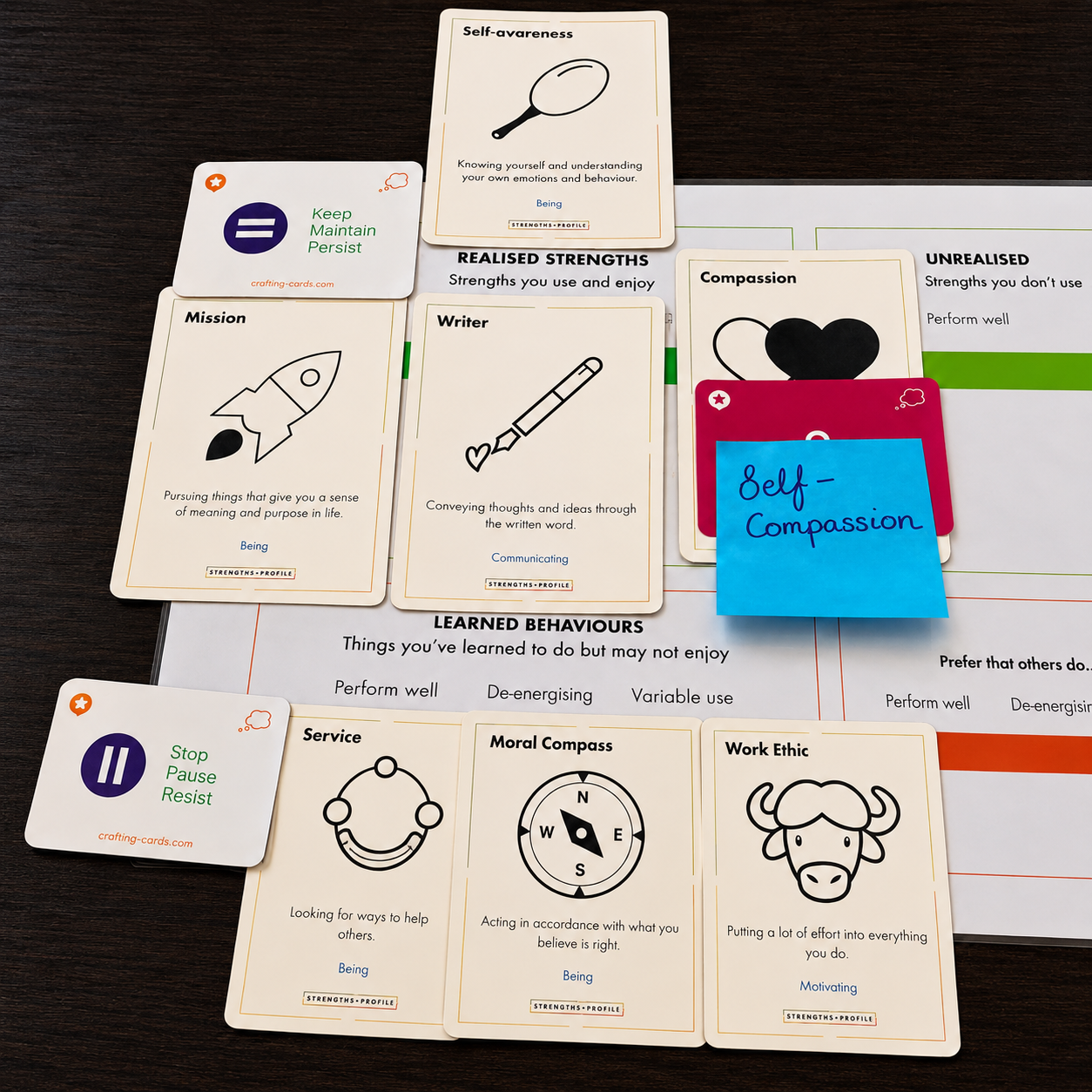
Strengths Profile cards © Capp & Co Ltd 2026. Crafting cards © Tailored Thinking / At My Best 2026.
LEADERSHIP COACHING
Which level of support is right for you?
The shape of the work depends on what you're navigating and what would be most useful right now. All leadership coaching options include both the Skills Discovery Expert and Leader Profiles, an optional preparation call, analysis of your profiles before we meet and a one-to-one debrief. What differs is the level of support available to explore what emerges, experiment where useful, and integrate what you learn over time.

1

Debrief
For when you want a clearer picture of what's going on for you before deciding what to do about it
A one-to-one debrief to make sense of your Expert and Leader Profiles and what stands out for you in your current role.
✓ Expert & Leader Profiles ✓ Preparation call (optional) ✓ 1:1 debrief session (60 mins)
Includes
2
Anchor
For when you know something needs to change, but you're not yet sure what to try first
Builds on the debrief, with two further coaching sessions to explore what you want to focus on, choose a small, practical experiment, and learn from what happens.
Includes
✓ Everything in Debrief ✓ 2 additional coaching sessions ✓ Strengths crafting resources ✓ Guided reflection resources

3
Integrate

For when you're in the middle of something that isn't going to resolve quickly, and want support as you work through it
Provides four further coaching sessions to reflect on what is changing, try small adjustments, and learn from what happens, with space to keep refining how you lead and where responsibility sits.
Includes
✓ Everything in Debrief ✓ 4 additional coaching sessions ✓ Strengths crafting resources ✓ Guided reflection resources ✓ Light email support

Investment in leadership coaching starts at $594 including GST for the Debrief package.
Additional travel costs may apply for in-person coaching. Reduced rates may be available where an organisation engages multiple leaders.
Two perspectives on your strengths
The two profiles provide different but complementary perspectives.
The Expert Profile gives a broader view across all 80 skills and helps keep the wider picture in view, including patterns across your work and life beyond your role.
The Leader Profile focuses specifically on leadership, exploring how your strengths influence the way you lead yourself, lead others and lead the organisation, including potential risks when strengths are overplayed.
Together, the profiles connect your strengths, energy and patterns of use with the demands of your leadership role, helping you see where familiar ways of working remain useful and where they may need to evolve.
Specialist strengths training
My work draws on advanced training in Strengths Profile (now Skills Discovery), including Master Practitioner accreditation and completion of the Strengths Profile Leader Programme.
“The Leader Profile is a brilliant tool for helping leaders develop their self-awareness to lead effectively and authentically. It supports in-depth coaching conversations on understanding key leadership strengths, leadership style, as well as identifying patterns and hidden risks.”
Sharon Quirk | Director, Optimising Strengths Originally published by Cappfinity

Finding the right starting point
Leaders often arrive with a question they have been circling for a while, a pattern they are starting to notice, or a sense that something in the way they are working needs attention.
You do not need to know whether coaching or supervision is the right option before you get in touch. You can contact me in whatever way feels most comfortable, by email, phone or through the website.
A complimentary 30-minute conversation gives us a chance to talk through what you are navigating, consider which starting point may be most useful, and check that we are a good fit before you commit. If I am not the right person for what you need, I will say so.
When the issue is bigger than one leader
Not every leadership challenge can be solved by changing how one leader works.
Small experiments can do more than create change. They can also help clarify what sits within a leader’s influence and what does not.
Sometimes things do shift. A different question, clearer expectation, or change in how responsibility is shared creates more room.
At other times, the experiment reveals that the constraint sits further out: in workload, role design, decision-making authority, team capability, or how work is distributed.
That is useful information too. It helps distinguish what the leader can change from what may need a wider organisational conversation.
Frequently asked questions
-
There is some overlap. Supervision can involve mentoring and coaching, but the main difference is the purpose and shape of the relationship.
Leadership supervision is an ongoing, agenda-led reflective relationship. Because I provide external supervision, it is separate from your organisation’s line management processes. You bring what is most relevant at the time.
The conversation may involve reflection, support, problem-solving, mentoring or coaching, depending on what is useful. It can also create space to identify areas you want to develop further.
Leadership coaching is usually more focused and bounded. It begins with Skills Discovery and a one-to-one debrief, providing a shared starting point for exploring your strengths, what your role currently requires of you, and an area you want to understand, develop or approach differently. When a practical change is needed, strengths crafting can provide a way to test small, practical adjustments and learn from what happens.
Supervision is a good fit if you want a regular reflective relationship that can move with the changing demands of your role. Coaching is a better fit if you want a focused process around a specific leadership issue or area of development.
Both use the same strengths-informed lens. In supervision, Skills Discovery is typically introduced within the first few sessions, and if something more pressing needs attention, we begin there. You do not need to decide which approach is right for you before getting in touch. The complimentary 30-minute conversation is a good place to work out what would fit best.
-
No. You may be in the process of stepping into leadership, leading a project or area of work, or carrying significant responsibility or influence without having a senior title.
The Leader Profile suits people at different stages, from aspiring to experienced leaders. But the work goes beyond the profile itself.
What matters more is what your role is asking of you. You may be taking on broader responsibility, finding that more decisions or support are coming through you, or needing to think differently about where responsibility and ownership sit.
Coaching or supervision can provide space to understand those shifts, how your strengths are showing up within them, and what may need to evolve as your role changes.
-
Skills Discovery gives us a structured picture of capability, energy and how different skills are being used. Unlike approaches that focus only on what you do well, it considers performance, energy and use, distinguishing Realised Strengths, Unrealised Strengths, Learned Skills and Weaknesses.
These distinctions help us explore what you do well and find energising; capabilities that energise you but may be used less often; things you perform well at greater energetic cost; and areas where support or a different approach may be useful. We can also notice where strengths may be getting overplayed or relied on heavily.
The profile is a starting point for inquiry rather than an explanation of you or a prescription for what should change. We explore what it reveals alongside the realities of your role, responsibilities, relationships and wider context.
In coaching, the profile and debrief provide the starting point for more focused developmental work. In supervision, it is typically introduced within the first few sessions and used as one lens among others. It can also help me tailor the pace, structure and style of reflection in ways that fit your strengths and preferences.
-
Yes. What you discuss in leadership coaching and supervision sessions is confidential, including when your organisation is funding the work.
Your Expert and Leader Profiles are yours, and I do not share them with your organisation unless you ask me to.
There are normal limits to confidentiality. For example, information may need to be shared where there is a serious concern about someone's safety or a legal requirement to disclose it. If a situation arose where I believed information needed to be shared, I would discuss this with you first wherever possible, including what would be shared and with whom.
Where an organisation is funding the work, they may sometimes ask for general themes or an overview of how the work is progressing. This does not include details from individual conversations, except where the confidentiality limits described above apply. Any expectations about reporting or information-sharing are agreed with you and your organisation at the outset so you know what is and is not confidential before we begin.
If your Skills Discovery profile is part of a broader team or organisational program, individual Expert Profile results may be combined into a Team Profile. This shows patterns across the group rather than individual results. How your profile information will be used, including any team-level reporting, is explained before you take part.
-
The online Skills Discovery assessment usually takes around 30 minutes and gives you both your Expert and Leader Profiles. In coaching, you complete it at the start. In supervision, it is typically introduced within the first few sessions.
Leadership supervision sessions are one hour. Most people meet monthly, although you choose how often.
Leadership coaching sessions are also one hour. The timing and frequency of sessions can be agreed around your goals, availability and the level of support you choose. Sessions may be spaced to give you time to test something small in your work and learn from what happens before we meet again, rather than taking on an ambitious new routine.
If you begin with the Debrief, the initial commitment is simply the assessment, an optional 30-minute preparation call and the one-hour debrief. Anchor adds two further one-hour coaching sessions. Integrate adds four further one-hour sessions over a longer period, with light email support.
Other ways to engage with this work

Public Workshops
Explore practical ways to adapt how you use your strengths, shape responsibility and work more sustainably, alongside other leaders.
Two-day workshop
Half-day workshop coming soon

For Organisations
Explore how strengths, responsibility and reliance are shaping leadership and team dynamics, and where changes to roles, expectations or ways of working could support more sustainable contribution across your organisation.